“That Is Forbidden… Don’t Look.” — The Rancher Still Looked… And Did The Unthinkable.
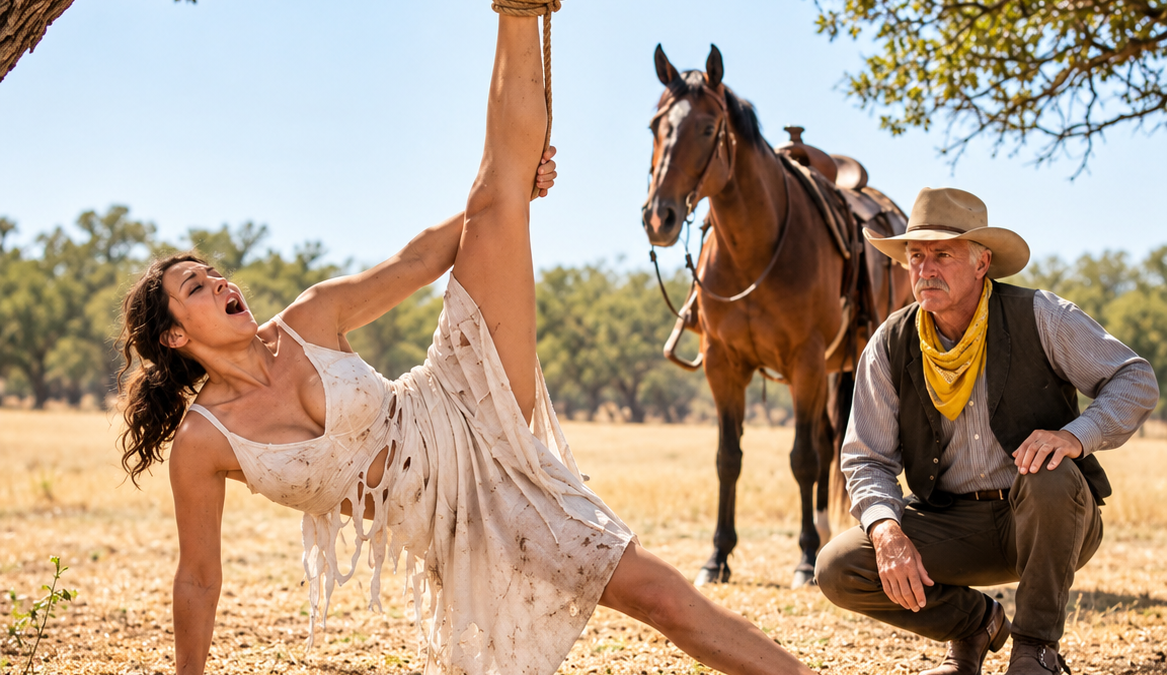
PART 2:
Checked the edge of his knife and tucked his canteen where it wouldn’t bounce. Small moves, quiet moves, the kind an old man makes when he’s learned that loud courage gets you buried. Clara watched him anyway. She didn’t ask a single question, but her fingers tightened around the coat like she knew
the world had teeth. Elias gave her one look, not at her body, but at her face, and he saw it. She wasn’t just scared. She She was measuring him, testing if he was the kind of man who helped for a minute, then sold you for a dollar, and somewhere behind them, the riders kept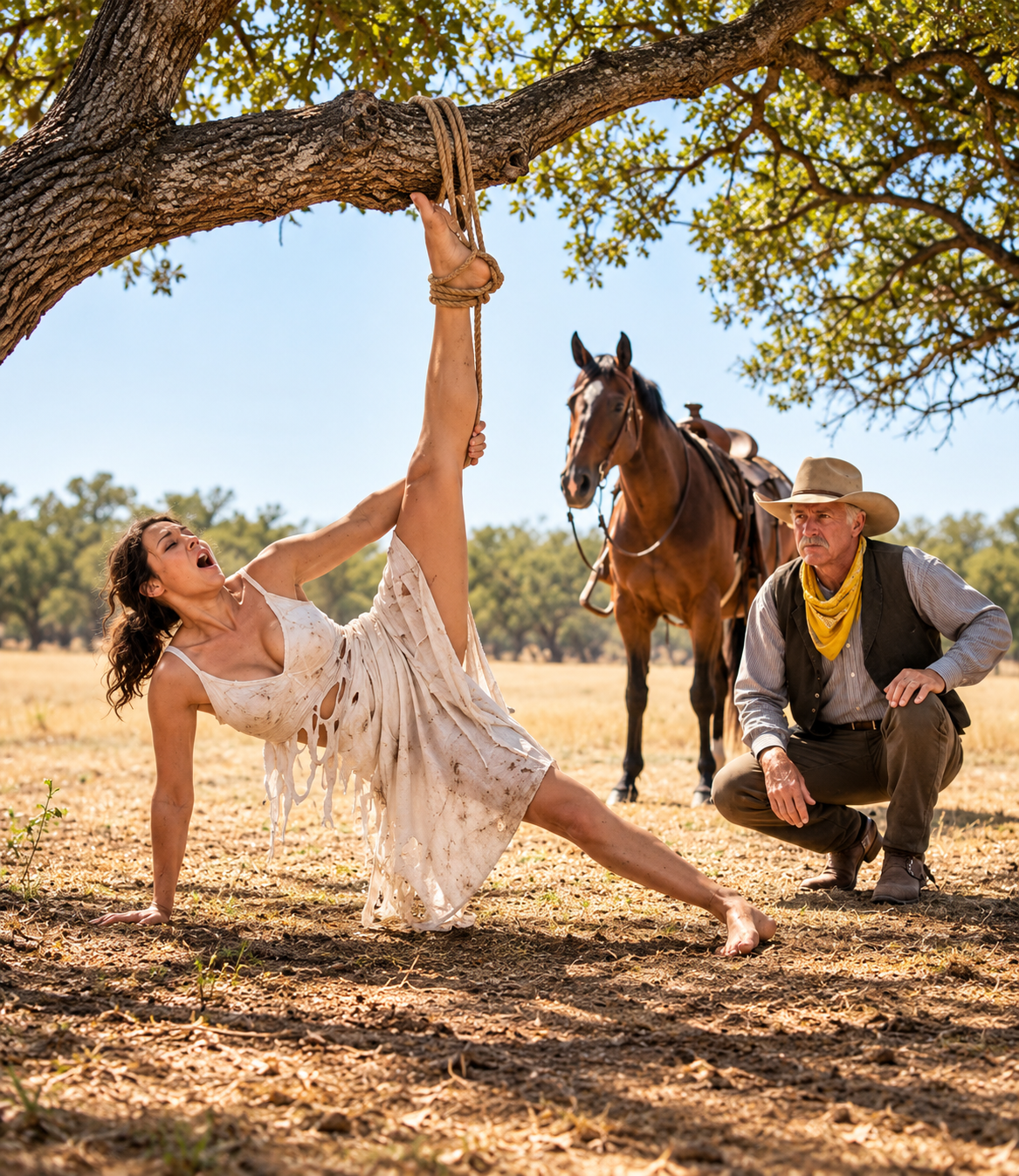
coming. This isn’t a story about looking. It’s a story about what a man does after he realizes he looked wrong. The rancher’s name was Elias Mercer, 60 years old, shoulders still broad from a lifetime of lifting fence posts and saddle bags, but his eyes carried more
years than his hands ever could. He lived alone on a dry stretch of land south of the Great Western Trail, the kind of place folks only rode through if they had no better option. Elias kept his face turned toward the open prairie while his hands worked by memory. He shrugged off his coat, thick and sunfaded, and held it out toward the
girl without looking back at her. “Cover yourself,” he said quietly. His voice wasn’t gentle, but it was steady. “I ain’t looking again.” She hesitated, then used her free hand to pull the coat over her chest and waist, clutching it like a lifeline. Only then did Elias step closer, eyes fixed on the rope. The
knot, the way it was tied, that was when he noticed something that made his jaw tighten. The knot wasn’t sloppy. It wasn’t the work of a drunk or a desperate fool. It was clean, efficient, the kind of knot men used when they tied cattle fast and meant to come back.
Someone had done this on purpose, and they weren’t far. Elias cut the rope with one sharp pull of his knife. The girl sagged, nearly collapsing, and he caught her by the elbow. careful, deliberate, never pulling her close. She was lighter than she looked. All bone intension, like a wild thing that hadn’t
eaten right in days. They left me, she said, breath ragged. Couldn’t haul me fast enough. Said I’d still be here when they came back. That was when Elias felt the anger settle in his gut. Heavy and familiar. Not the hot anger of youth, but the cold kind that comes when you
recognize a pattern you’ve seen before. He glanced at the ground. Bootprints, three horses, maybe four. All pointed north. “They don’t want you going north,” Elias said. Her eyes snapped up to him. Sharp, alert, too alert for a helpless girl. “No,” she said. “They
don’t.” She tried to stand on her own and nearly fell again. Elias steadied her, then stepped back, giving her space. “Respect wasn’t something you announced. It was something you showed by where you stood. What’s your name?” he asked. “Chara,” she said. “Cla Voss.”
Elias nodded once. “Names mattered out here.” The wind shifted, carrying the faintest sound. “Hooves! Distant, but coming.” Elias handed her his canteen and turned toward his horse. “Drink,” he said.
“Then we move. They’ll be back.” Clare took a long pull, wiped her mouth, and looked at him with something like disbelief. You’re helping me, she said. Not a question. Elias swung into the saddle and looked down at her. Really?
Look now at her face. Not her body. At the at the grit behind her fear, at the resolve. I made a mistake a minute ago, he said. A man my age doesn’t get many chances to make one thing right anymore. He reached down and offered his hand.
The dust on the horizon thickened, and as Elias hauled her up onto the horse behind him, one thought burned through his mind. Who was Clara Voss to men powerful enough to leave her tied like an object in the Texas sun? And what would it cost him to carry her north anyway? So, here’s the question I want
you to sit with before we go on. When a man realizes he crossed a line, does doing one right thing make up for it? Or does it only pull him deeper into a fight he can’t walk away from alive? They didn’t ride far before the heat started to bite again. Elias kept the horse at a steady pace, not fast enough
to draw attention, not slow enough to invite trouble. Clare sat behind him, still wrapped in his coat, one hand gripping the saddle horn like she didn’t fully trust the ground yet. Neither of them spoke for a while. Out here, silence wasn’t awkward. It was how you listened. The dust cloud behind them
stayed thin. But Elias knew better than to relax. Men who tied a young woman to a tree didn’t quit easy. They circled. They waited. After a mile or so, Elias turned off the main trail and cut across a shallow draw where the grass grew high and the ground dipped low. He had camped
there more times than he could count. A small rough setup, a fire ring, a lean two made of canvas and stubbornness. Elias had built that lean two years ago, and it had one rule. If the wind changed, you paid attention. Right then, it changed. The smell came first. Not
smoke, not cattle, or sweat. Fresh and sharp like someone had ridden hard and stopped nearby. Elias walked a slow circle around the camp like he was checking for snakes. He wasn’t. He was reading the ground. A scuff where a boot heel had turned. A broken stem bent the
wrong direction. One small rock kicked out of place. He found a mark on the oak nearest the fire ring. Shallow cut, fresh, almost careless. The kind of mark a man leaves when he wants you to know he was there. Elias didn’t smile. He didn’t curse. He just felt that old, cold anger settle again. He stepped back
to the lean to and adjusted the canvas, making a small pocket of shadow. Then he set his hat down like he planned to stay a while. Because when a man wants you scared, the worst thing you can do is look scared. This is where I stop most nights, he said. Waters close, shade
holds till sun down. Clara slid down from the horse slowly, legs shaking. Elias pretended not to notice and went straight to the canteen in a sack of dried meat. “Eat,” he said, setting it near her without looking straight at her face. “You’ll think clearer after.”
She did eat. Not polite bites, not greedy either, just enough to stay standing. When she finally spoke, it wasn’t gratitude. It was something harder. “They weren’t going to kill me,” she said. Not right away. Elias nodded. He already knew.
They wanted me scared. She went on. Wanted me to stop trying to go north. They said if I stayed put, if I kept quiet, nothing worse would happen. Elias crouched by the fire ring, brushing ash aside. That’s how men like that talk when they plan on doing worse later. She
watched him carefully. Why help me? She asked. You didn’t have to. Elias took his time answering. He stacked kindling the way he always had. Neat and slow because I’ve been the man who looked the other way, he said. And it cost someone more than it ever cost me. That was all he gave her. It was enough. The sound of
hooves came sooner than Elias wanted. Not close yet, but clear enough to tighten his shoulders. He rose, moved calm, and led the horse behind the lean to. Three riders came into view on the ridge. One of them Elias recognized without seeing his face, Jeb Rusk rode like he owned every mile he crossed.
Lean, mean, always smiling like he knew something you didn’t. They stopped just short of the camp. Well now, Jeb called out. Looks like you picked up something that ain’t yours, old man. Elias stepped forward alone, hands open, calm as a fence post. She
needed water, he said. That’s all. Jeb’s eyes flicked past him. Hunting. Girls been causing trouble, he said. Belongs to someone up north. Clara stiffened behind the canvas. She doesn’t belong to anyone. Elias said. His voice stayed even. But she’s standing on my ground.
Jeb laughed. “Not loud. Just enough to let you know he didn’t take much seriously.” One of Jeb’s men moved wrong, reached out, grabbed at the canvas. Elias moved faster than a man his age had any right to. He stepped in, hooked the wrist, twisted sharp and
short. Bone didn’t break, but pain did its job. The man went down, swearing, dust in his mouth. Elias didn’t follow him, didn’t kick him, just stood there breathing, eyes steady. “That’s enough,” Jeb said, holding up a hand. He studied Elias now. Really studied him. Didn’t
know you were that kind of old, Jeb said. But this ain’t finished. No. Elias said it isn’t. The riders backed off slow. Not defeated. Marked. As soon as they were gone, Clare exhalded like she’d been holding her breath since the tree. “You didn’t have
to do that,” she said. Elias shrugged. Once a man steps in, he might as well stand his ground. That night came heavy and hot. They ate quiet, fire low, crickets loud. Elias took the first watch, an old habit. Clara slept wrapped in the coat, face turned away from the
fire sometime before dawn. Elias heard it, a soft step, careful, he rose without sound, circled wide, and caught a shadow slipping away from the horse. Nothing was taken, no money, no gun. Just the place near the saddle where Clara had tucked something flat
and folded. Elias sat back down when the dark swallowed the figure. They weren’t hunting her. They were hunting what she carried. What she carried was not romance, not jewelry, not some silly letter. It was a folded survey map and a stamped railroad document. Proof that Wade Hollister was trying to steal land
by turning ink into a weapon. By morning, Elias had made his decision. “We’re riding north,” he said. “To Dodge City,” Clara looked up sharp. “That’s where they’ll be waiting.” “That’s where people ask questions,” Elias said. “And
sometimes questions are louder than guns,” she studied him, then nodded once. As they saddled up, Elias paused and looked back at the camp. He knew this stretch of land, knew every sound it made, and he knew one thing for certain. Helping her had already crossed a line he couldn’t uncross before we
ride any farther. If this story feels like the kind you want to see through, take a second and subscribe. It helps keep these old stories alive. And if you’re still with me, pour yourself a cup of tea or coffee, settle in, and tell me this. What time is it right now? And where are you listening
from? Because the road north is where things stopped being simple. They rode north at first light. The land opened up the way it always did on the great western trail. Flat stretches where the sun had no mercy. Low rises where you could see trouble coming and still not have time to stop it. Elias kept them moving
steady. Not pushing the horse. Not babying it either. A tired horse was safer than a fresh one when men were watching from a distance. Clare sat straighter now. Not relaxed, just alert. She had stopped looking like someone who needed to be carried. That worried Elias more than if she’d stayed scared. They
joined a small cattle drive before noon. A halfozen dvers pushing long horns north. Dust hanging thick in the air, bells clinking slow. No one asked questions. On the trail, folks learned fast that answers cost more than silence. One of the dvers caught Elias’s eye early on. a narrow man with sharp
features and restless hands. Name was Lim Carter. He smiled too quick and watched too long. Elias clocked it and kept his mouth shut. By late afternoon, the heat pressed down hard. They stopped near a shallow creek where the water tasted like iron and regret. Men sat in the shade, boots off, hats low. Clara
stayed close to Elias without meaning to. Not fear exactly, instinct. As they rested, Elias told her a piece of the truth, not the whole thing, just enough to explain why he had turned back at that tree instead of riding on years ago. Before his hair went gray,
Elias had helped a man smooth out a land claim. It looked clean on paper, legal enough. Only later did he learn a family was pushed off ground they had worked for decades. He never saw him again, but he saw their faces every time he passed an empty house. I don’t fix thing, he
said. I just try not to break more. Clara listened. Did not interrupt. Did not judge. That night the attack came quiet. No gunfire. No shouting. Just cattle spooked and men scrambling in the dark. Someone cut the
rope on a steer. Another cracked a whip where it would echo. Chaos without blood. The kind meant to scatter people, not kill them. Elias moved on instinct, grabbed a horn, swung a gate, kept bodies between Clare and the dark. Hands grabbed him once. He twisted free. A
fist connected. Someone went down hard. By the time the noise faded, two cattle were gone and the camp was shaken. Elias counted heads. All there except something felt wrong. He checked the saddle. The spot where Clara had tucked a folded piece of paper was empty. That
paper was the difference between a quiet life and a stolen future. She saw his face change. They took it, she said quietly. Not all of it, Elias said. Or they would have taken you instead. That was when Lim Carter avoided his eyes.
Elias did not call Lim out. Did not draw steel. He waited. The next day, they rode harder. The sky turned white hot. Sweat dried before it fell. Men talked less. Elias watched Lamb drift close to the rear. Watched him study Clara when he thought no one noticed. Clara
noticed, too. She did something smart. She let Lamb see her adjust the saddle again. Let him think she was careless. Let him think there was still something worth stealing. That night, Lim took the bait. Elias followed without a sound. No fight, no shouting, just a quiet
confrontation by the creek where the frog stopped singing. Limb broke faster than Elias expected. Not evil, just trapped. Hollister had bought his debt, owned him on paper, told him to watch the girl and take what he could. Elias took back what was stolen and let lamb
walk. Run, he told him. And don’t look back. By the third day, Dodge City sat on the horizon like a promise and a threat. Rail smoke, dust, noise. Clare stared at it longer than she should have. That’s where they want me quiet, she said. That’s where quiet
costs money, Elias said. And noise costs more. He believed that. What he did not know was how expensive it was about to get. As they rode closer, Elias felt the shift. The trail rules fading, town rules taking over.
And somewhere ahead, someone with a badge was already deciding how this story would end. Dodge City hit them all at once. Not the buildings, not the people, the noise. Iron on iron, cattle balling in the pins, steam hissing from rail engines, men shouting numbers,
prices, names, money changing hands faster than eyes could follow. Elias felt it before he saw it. The trail rules were gone out here. Dust didn’t decide things. Paper did. They rode in slow, blending with the drive. Longhorns pressing tight. Hooves packed hard into
the street. Clara kept her head down, hat pulled low, coat