Billionaire Dropped His Wallet In A Gas Station. Cashier Making $9/Hour Drove 40 Miles To Return It
Parte 1
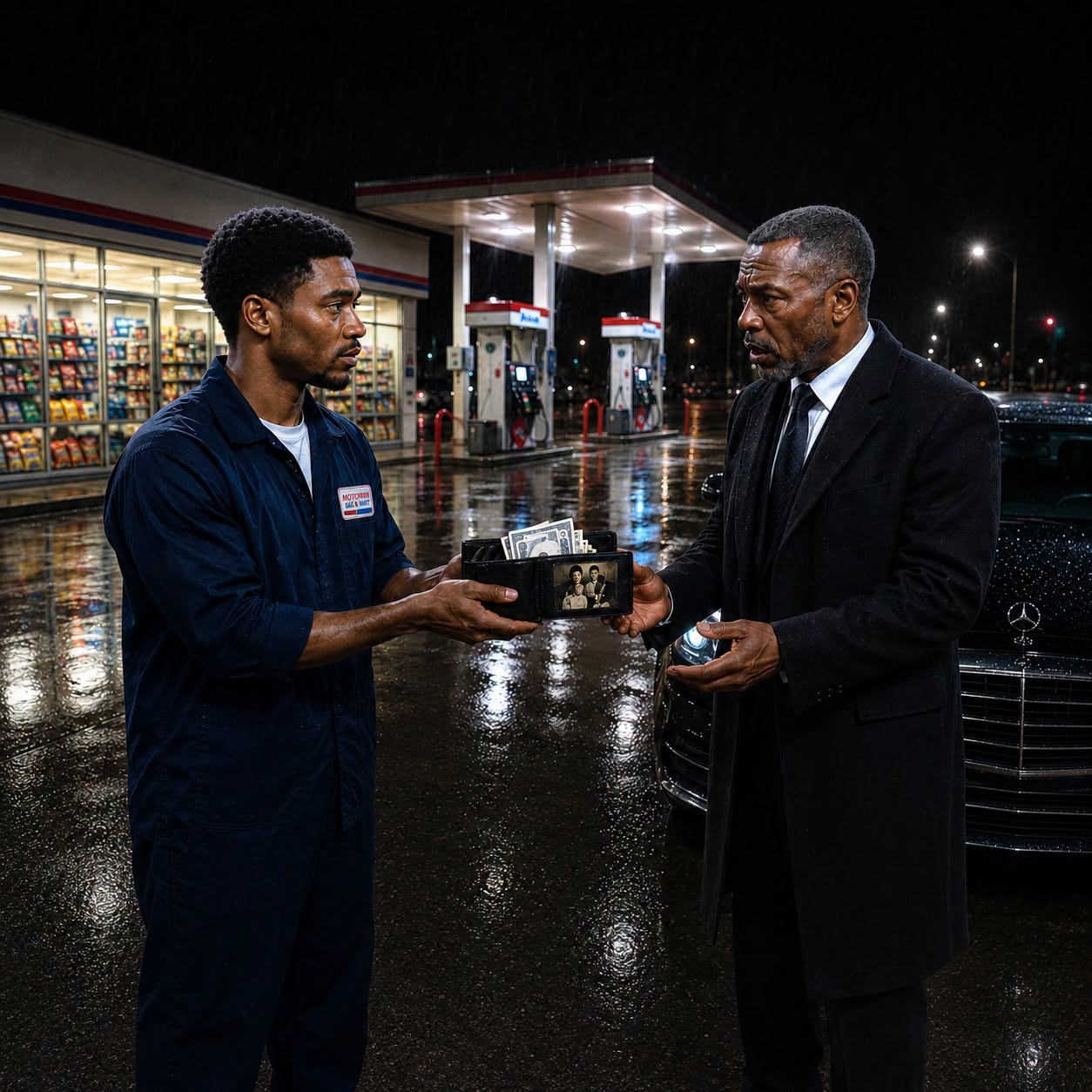 The night a billionaire’s wallet fell behind a dusty biscuit shelf at a filling station, a poor cashier’s sister slapped him and screamed that only a fool would return money while their mother was dying.
The wallet was black leather, soft like it had never known hunger. Inside were $4,300, 3 bank cards, a diamond-stamped business card, and an old photograph of a woman in a white church hat, smiling under Easter sunlight. On the back, in fading blue ink, someone had written: Mama, Easter 1994.
Chinedu Okafor stood behind the counter of the filling station near Sagamu, his uniform smelling of petrol, sweat, and instant noodles. He was 26, thin from too many night shifts and too few proper meals. The station manager paid him ₦9,250 per night. His mother’s insulin cost more than that in 2 days.
His younger sister, Ada, had come to bring him garri and groundnuts after visiting their mother at the clinic. When Chinedu opened the wallet, Ada saw the money before he could close it.
—Chinedu, if you return that money, may thunder ask you questions.
—Ada, it is not ours.
—And Mama’s sickness is ours? The landlord’s threat is ours? The hospital bill is ours? God dropped this thing here because He has eyes!
Chinedu looked at the photograph again. The woman’s smile reminded him of Sunday mornings in Enugu before poverty became louder than hymns. His mother, Nneka, had raised him with one sentence that followed him everywhere: a clean name is heavier than a full pocket.
But Ada was crying now.
—You want Mama to die so one rich man can clap for your honesty?
Those words entered Chinedu like a knife.
The wallet belonged to Alhaji Adewale Balogun, 56, founder of Balogun Meridian Group, a man whose name appeared on towers in Lagos, road contracts in Abuja, and oil service companies in Port Harcourt. His empire was valued at 9.4 billion. He owned houses in Ikoyi, London, Dubai, and Banana Island, yet he ate dinner alone at a table meant for 14 people.
Adewale had built his life on one belief: everybody had a price.
He had not always been rich. He grew up in a cramped room in Mushin with a mother who sold akara before sunrise and prayed until her knees swelled. At 23, he saved 47,000 from small supply contracts and gave it to his elder half-brother, Kola, so they could start a business together. Kola disappeared with the money, the documents, and the woman Adewale planned to marry.
That betrayal did not just wound Adewale. It rebuilt him.
For 31 years, he trusted nobody fully. Not partners. Not staff. Not pastors. Not even his own daughter, Zainab, 21, who had stopped speaking to him 4 months earlier after he accused her of loving him only because of inheritance.
—You count money better than you count hearts, Daddy.
That was the last thing she told him.
That evening, Adewale had been driving from Lagos toward Ibadan to visit his mother’s grave in a small family cemetery. He stopped at the filling station, bought bottled water, ignored Chinedu’s polite greeting, and drove away without noticing the wallet had slipped from his agbada pocket.
Now Chinedu held a fortune that could save his mother, pay their rent, settle the hospital, and return him to the accounting exams he abandoned after Nneka’s stroke.
Ada blocked the door.
—If you walk out with that wallet, do not come back and tell me Mama needs medicine.
Chinedu’s hand shook, but he put the wallet inside his jacket.
—If Mama wakes and hears I stole from a stranger, the medicine will not heal her heart.
He borrowed the station’s old motorcycle because his own car had died 3 weeks earlier. Rain started falling as he rode 40 km through the dark toward Ibadan, following the hotel name he had found on a fuel receipt inside the wallet.
By 12:18, soaked and shivering, he reached the hotel lobby. Adewale was not downstairs. The receptionist refused to reveal the room number, so Chinedu sat on a leather sofa, the wallet on his lap, while rich guests walked past him like he was part of the furniture.
At 6:40 in the morning, Adewale stepped out of the elevator.
Chinedu stood.
—Sir, you dropped this.
Adewale stared at the wallet, then at Chinedu’s wet shoes.
—How much did you take?
Chinedu froze.
—Nothing, sir.
Adewale opened it. The money was complete. The cards were complete. Then he reached the photograph.
His face changed.
Not surprise. Fear.
He grabbed Chinedu’s wrist.
—Where did you get this picture?
Chinedu’s breath caught.
—Sir, it was inside your wallet.
Adewale turned the photograph over again, staring at the handwriting like a ghost had spoken.
Then he whispered one name Chinedu had not expected to hear.
—Nneka.
Parte 2
Chinedu felt the hotel floor tilt under him. His mother’s name in Adewale Balogun’s mouth sounded impossible, like hearing a stranger call out a secret from inside his own house. —How do you know my mother? he asked. Adewale released his wrist slowly, but his eyes stayed on the photograph. For the first time in years, the billionaire looked less like a man who owned buildings and more like a boy standing in front of a locked door. —Your mother is Nneka Okafor? From Enugu? Chinedu nodded, suddenly defensive. —She is sick. She has no time for rich men’s questions. Adewale folded the photograph with trembling fingers and offered $500. —Take this. For returning it. Chinedu looked at the money and remembered Ada’s tears, the hospital smell, the insulin bill, the landlord’s padlock threat. For a moment, temptation stood between them like a living thing. Then he stepped back. —I did not come for reward. I came because the wallet is yours. Adewale’s jaw tightened. —Nobody rides 40 km in the rain for free. —My mother said a man who sells his name cheaply will spend his life buying it back. Adewale had no answer. Chinedu turned to leave, but Adewale blocked him. —Wait. I need to see your mother. —No. Chinedu’s voice was sharp. —You rich people always arrive when somebody is weak. You ask questions, open wounds, then drive away. Adewale flinched because it was true enough to hurt. Still, 2 days later, he appeared at the public clinic in Ibadan where Nneka lay on a narrow bed, her feet swollen, her Bible open beside her. Ada saw him first and almost called security, but Nneka looked up and went still. —Adewale, she whispered. Ada turned to Chinedu. —Mama, you know him? Nneka closed her eyes. Her shame was older than her sickness. Years before Chinedu was born, before Lagos swallowed Adewale’s softness, Adewale and Nneka had loved each other in secret. But Kola, Adewale’s half-brother, wanted both the business money and Nneka. When Nneka refused him, Kola lied. He told Adewale she had betrayed him for another man. He told Nneka Adewale had used her and married elsewhere. Then he vanished with Adewale’s savings. Nneka left Lagos pregnant, heartbroken, and proud. She never told Chinedu because she did not want him chasing a father who had already chosen silence. Adewale gripped the metal bed rail as if it was the only thing keeping him standing. —Pregnant? Nneka, pregnant with who? The room went silent. Ada covered her mouth. Chinedu stepped back. His whole life cracked open in one sentence. Nneka began to cry. —I wanted to tell you. But when I came to your office, your guards pushed me outside. Kola met me by the gate. He said you knew and wanted nothing to do with the child. Adewale’s face hardened with a rage that had waited 26 years for a name. —Kola. Chinedu shook his head. —No. Do not do this. Do not walk in here with a wallet and turn my mother’s pain into your family drama. Adewale reached for him. Chinedu moved away. At that exact moment, Adewale’s phone rang. It was Zainab. Her voice came through cold and frightened. —Daddy, Uncle Kola is at the house. He says if you do not sign the land transfer tonight, he will release documents proving you abandoned a son in poverty.
Parte 3
Adewale did not go to the police first. He went to his mother’s old wooden box in the family house in Abeokuta. For 11 years, it had remained locked under a bed, covered in dust and memory. Inside were church programs, faded wrappers, receipts from akara sales, and letters tied with a red thread. One letter carried Nneka’s handwriting. Another carried Kola’s. The truth sat there quietly, waiting for the day pride would stop shouting over it.
Kola had intercepted Nneka’s letters. He had forged replies. He had used Adewale’s heartbreak to steal money, steal a woman’s dignity, and later build a life pretending to be loyal family. For 26 years, he had known Chinedu existed.
That night, Adewale gathered everyone in his Ikoyi house: Zainab, Chinedu, Ada, Nneka in a wheelchair, and Kola standing near the window with the arrogance of a man who had escaped consequences too long.
—You cannot shame me with my own blood, Adewale said.
Kola laughed.
—Blood? When did you remember blood? After a poor boy returned your wallet?
Chinedu stood beside his mother, fists clenched. He did not want the mansion, the name, the inheritance, or the cameras that had already gathered outside after whispers spread online. He wanted the past to stop choking his mother.
Zainab looked at Chinedu, then at her father.
—Is he my brother?
Adewale’s voice broke.
—Yes.
Nneka wept silently.
Kola tried one last lie.
—Ask her how many men she knew then.
Before Adewale could move, Ada stepped forward and slapped Kola so hard the room froze.
—Say one more word about my mother and even your ancestors will feel it.
For the first time, Zainab smiled through tears.
The lawyers came with documents. The police came with old evidence, new threats, and recordings Kola had made while trying to blackmail Adewale. By morning, Kola was gone in handcuffs, shouting that everybody in that house was pretending to be holy.
But the real judgment happened after the police left.
Adewale knelt before Nneka.
Not as a billionaire. Not as a chairman. Not as a man used to being obeyed.
As the young man he had buried under 31 years of suspicion.
—I believed a lie because the lie was easier than pain. I let pride finish what Kola started. I cannot return 26 years. But if you allow me, I will spend what remains repairing what I broke.
Nneka touched his face.
—You did not break everything. Look at him.
She pointed at Chinedu.
—He became good even without your money.
That sentence humbled Adewale more than any insult could have.
Chinedu did not accept him quickly. There were no instant hugs, no magical forgiveness, no perfect family photo under bright lights. He asked for time. He asked that his mother’s treatment be paid without conditions. He asked that Ada return to school. He asked that nobody use his story for reputation.
Adewale agreed to everything.
Then Chinedu added one more condition.
—I still want to become an accountant. Not your son in public first. Not your project. Not your charity. Let me build something honest.
Adewale nodded.
—I will open the door. You will walk through it yourself.
Over the next 14 months, Chinedu studied, worked, failed 1 exam, tried again, and passed. Adewale funded a small office in Ibadan called Okafor Community Accounts, where market women, drivers, widows, small traders, and immigrants could file taxes, manage savings, and avoid men who fed on confusion. Chinedu owned 70% of it. Adewale kept 30%, not for profit, but as a reminder that trust must have skin in the game.
Zainab came often. At first, she came to observe the brother poverty had hidden from her. Later, she came with food, laughter, and old anger slowly melting into something like family.
One Sunday evening, she stood at Adewale’s dining table, where 14 chairs no longer looked like furniture in a museum. Nneka sat beside Ada. Chinedu sat across from Zainab. There was jollof rice, pepper soup, fried plantain, and too many people talking at once.
Adewale looked at the noise around him and almost cried.
Zainab leaned toward Chinedu.
—Do you know what you returned that night?
Chinedu smiled.
—A wallet.
She shook her head.
—No. You returned our father.
Years later, people still told the story of the cashier who returned $4,300 to a billionaire. Some called him foolish. Some called him blessed. Some argued online for days about what they would have done if their mother was sick and nobody was watching.
Chinedu never argued with them.
He knew the truth was heavier than the comments.
A wallet could hold money, cards, and old photographs. But sometimes, when carried by the right hands, it could also carry buried sons, broken daughters, stolen years, and a father’s last chance to become human again.
And on quiet mornings, when Chinedu unlocked his office before sunrise, he still heard his mother’s voice behind him like a prayer.
A clean name is heavier than a full pocket.